Cancer, Part 1: The Problem — What Cancer Is, Why It Happens, and What You Can Do About It
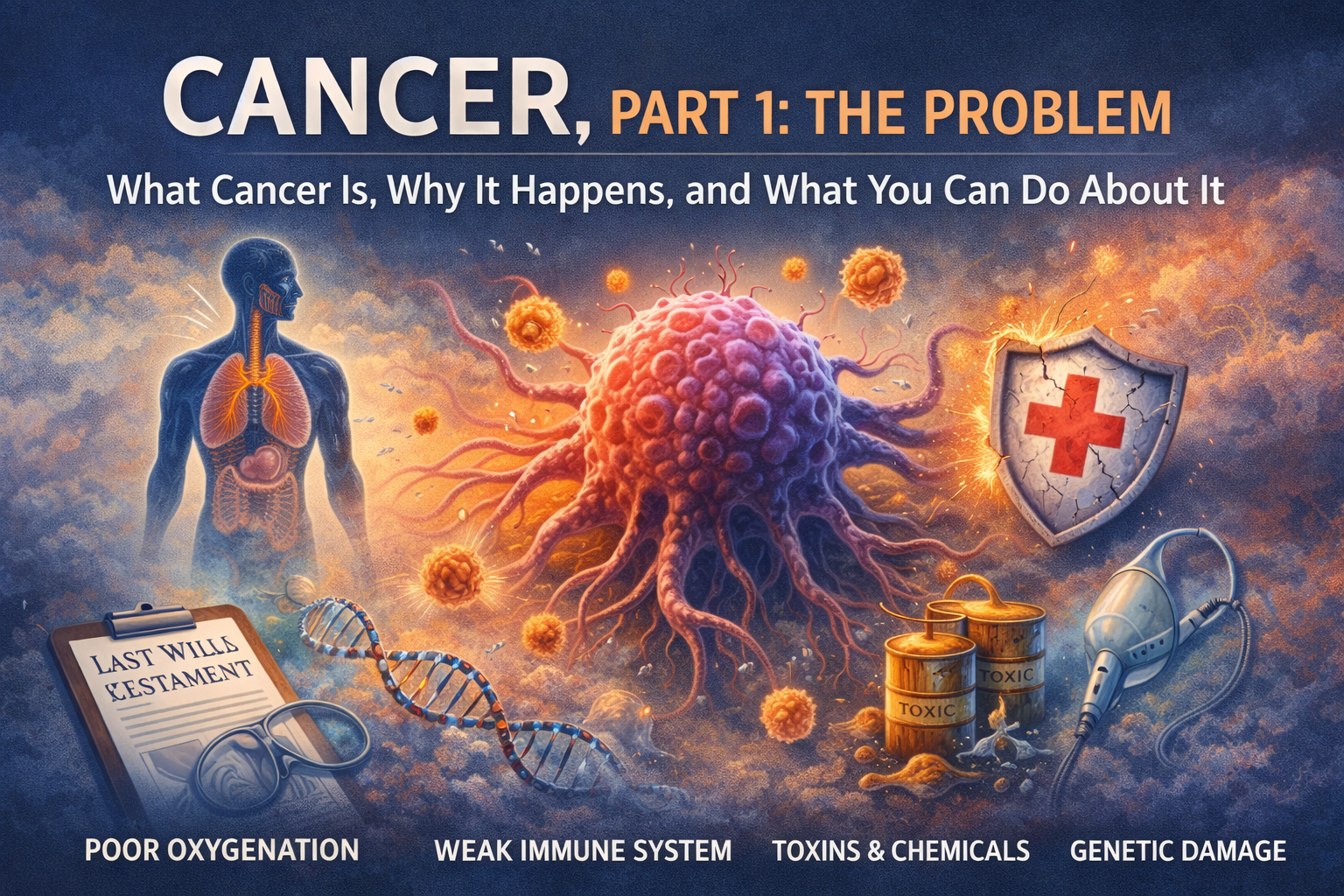
Cancer is the second-leading cause of death—and while it’s a heavy topic, it’s also one we can approach with clarity, strategy, and hope.
This is Part 1 of a four-part series focused on understanding the problem of cancer: what it is, why it develops, why rates may be increasing, and how a Structure-Function approach can support prevention and resilience alongside conventional care.
What Is Cancer?
Your body is constantly renewing itself. Over time, most of your tissues are being rebuilt and replaced—cell by cell. That ongoing process requires controlled growth.
Cancer is what happens when cellular growth becomes uncontrolled.
Instead of being regulated by the body’s normal “checks and balances,” abnormal cells begin reproducing on their own—growing, spreading, and competing with the body for resources.
The word cancer comes from the Greek term for “crab,” because early physicians noted that tumors could look like a crab with “legs” or extensions reaching into surrounding tissue.
How Common Is Cancer?
Cancer is far more common than most people realize.
Roughly 4 out of every 10 people will develop cancer in their lifetime.
Estimates in the transcript noted that in 100 males, about 40 will get cancer; in 100 females, about 39 will.
That means cancer prevention isn’t a niche conversation. It’s a human conversation.
“Do We All Have Cancer Cells?”
In a sense, yes.
It’s not unusual for abnormal cells to form in the body. The bigger question is: does your body have the ability to keep them under control?
A fascinating point raised in the transcript: researchers explored whether cancer cells could be detected and “counted” as a predictor of future disease. But they found that nearly everyone has abnormal cells, and the number of these cells didn’t predict who would go on to develop cancer.
What matters most is whether the body stays in a state where it can regulate and eliminate abnormal cells effectively.
The Five Core Triggers That Can “Kick Off” Cancer
The discussion outlined five major factors that can shift the body out of balance and allow abnormal cells to grow unchecked:
1) Poor Oxygenation
Oxygen plays a critical role in cellular metabolism and healthy regulation. Low oxygen states can create an environment where abnormal cells are more likely to thrive.
2) A Weakened Immune System
Your immune system includes specialized cells that help identify and destroy abnormal cells. When immune function is depleted, surveillance drops.
3) Genetic Damage (Mutagens)
Damage to the nucleus of the cell can lead to abnormal replication patterns. This can be driven by inflammation, oxidative stress, and toxin exposure.
4) Xenobiotics: Toxins, Chemicals, Heavy Metals, Infections
“Xenobiotics” simply means foreign substances that don’t belong in the body—chemicals, heavy metals, parasites, viruses, and certain bacteria.
In the transcript, infections were specifically highlighted as established contributors to some cancers (including examples such as Helicobacter pylori, hepatitis viruses, Epstein–Barr virus, HIV, and others). There was also a clinical story shared of a patient whose colon cancer diagnosis improved after addressing parasites identified through testing.
5) pH Imbalance
Cancer biology is complex, but pH shifts were emphasized as one of the factors that can change cellular behavior and regulation. In this view, minerals play a major role in maintaining proper pH balance.
Are Cancer Rates Getting Worse?
The transcript pointed out something important: cancer diagnoses appear to be increasing, and while some debate exists about whether that’s due to better detection, the viewpoint shared was that our increasingly toxic environment may be a major driver.
The good news?
Are Cancer Death Rates Improving?
Yes—overall, survival rates have improved, largely because:
We’re catching cancers earlier with better diagnostics
Treatments have improved for many cancer types
The “house fire” analogy is simple and accurate:
If the fire is still in the wastebasket, it’s easier to put out. If the whole house is engulfed, the situation changes dramatically.
The Most Common and Most Deadly Cancers
Most common cancers:
Women: breast, lung, colon
Men: prostate, lung, colon
Most deadly cancers (by mortality):
#1: lung cancer (for both men and women)
Then breast cancer (women), prostate cancer (men)
Colon cancer (both)
Pancreatic cancer was also highlighted as a major cause of cancer death
Who Is Most at Risk?
Age
Cancer risk rises with age:
About 85% of cancers occur in people 50+
About 50% occur in people 65+
Geography and lifestyle patterns
Areas with higher smoking and obesity rates tend to have higher cancer rates and mortality.
Smoking (and Secondhand Smoke)
Smoking was emphasized as the single biggest determinant affecting cancer risk—not only lung cancer, but bladder, kidney, colon, throat, and more.
Secondhand smoke was also described as especially concerning, with an anecdote shared about studies finding higher toxin markers in people exposed nearby than in the smoker themselves.
Kids and Cancer: Fluoride, Heavy Metals, and Vulnerability
Children can get cancer (often leukemias are referenced). The transcript emphasized that children:
Absorb certain toxins more easily than adults
May be more vulnerable to heavy metals
A claim was also made that fluoride/bromide/chloride are carcinogenic and iodine/iodide is anti-cancer, along with a mention of policy changes. (If you want this blog to include citations and be medically tighter for public posting, I can revise this section to ensure it’s framed appropriately and supported by reputable sources.)
Stages of Cancer
Cancer progression was summarized in stages:
Stage 0 (in situ): confined to tissue of origin
Stage I: growing
Stage II: invading surrounding tissue
Stage III: larger mass and/or lymph involvement
Stage IV: metastasis (spread to other organs)
Diet and Cancer Prevention: Why Fiber Is the Headliner
Diet was described as a major driver in cancer prevention—an estimate shared was around 65%.
And the “number one supplement” emphasized?
Fiber.
Fiber supports:
Healthy elimination
Reduced inflammation
Better metabolic balance
A healthier gut microbiome
The transcript also connected fiber to GLP-1 production (a hot topic because of GLP-1 medications), and described how gut bacteria balance can influence whether calories are stored or used effectively.
The key takeaway: modern diets often flip the historical pattern:
Then: high fiber, low sugar
Now: high sugar, low fiber
Infections and Cancer: A Missing Piece for Many People
A major theme: some cancers are associated with infections (bacterial, viral, parasitic). Stomach cancer was used as a powerful example:
It used to be far more common
Improved sanitation reduced infections such as H. pylori, and rates fell
The Role of Structure-Function Care in Cancer
At Holistic Integration, the model described is Structure-Function Care—not “treating cancer” directly, but supporting the body back into balance (homeostasis).
Homeostasis = health
The premise is:
Cancer develops when the body is out of balance
Supporting oxygenation, immune health, detox pathways, pH balance, and nutrition can strengthen the terrain and improve resilience
Why both models matter
A powerful framework was shared:
80% of care should be Structure-Function (supporting health and balance)
20% should be Disease Care (surgery, chemo, radiation)
Surgery, in particular, was described plainly:
“If you can cut it out—cut it out.”
Structure-function support is meant to work alongside oncology care, not replace it—and the transcript stressed the importance of having an oncologist involved.
A Note on Outcomes
A story was shared of a patient with stage 4 colon cancer exceeding the initial survival expectations while combining conventional oncology care with strong supportive structure-function care—aimed at maintaining oxygenation, immune health, detox capacity, and nutrition.